

The Safer Future Capability Framework
Build the capability to act under disruption—and adapt as conditions change.
Plans matter, but they do not tell you whether leaders, relationships and systems will perform under pressure.
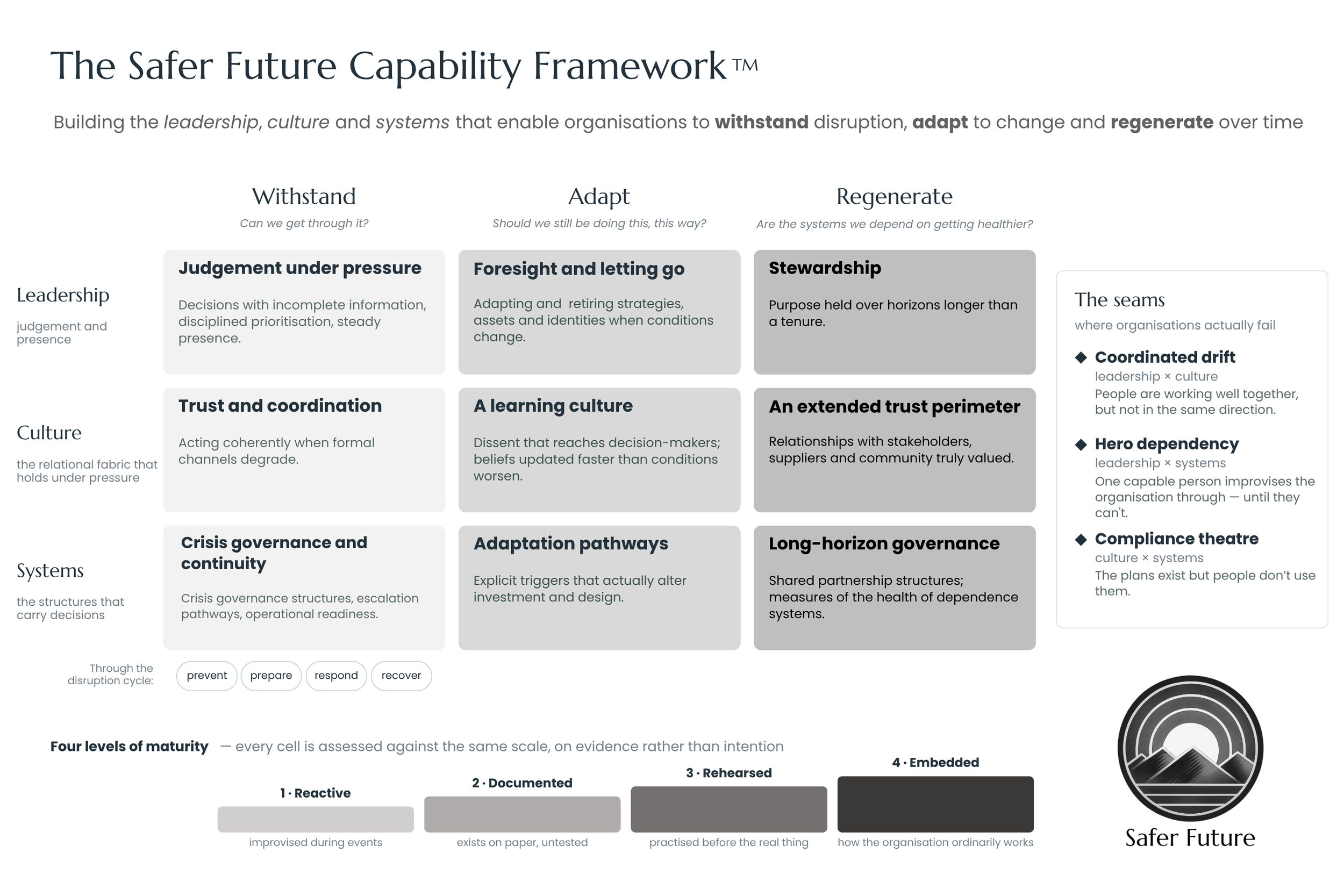
The Safer Future Capability Framework guides practical work across leadership, culture and systems, from immediate crisis readiness to long-term adaptation and stewardship.
The aim is not simply to help organisations produce better plans but to build the capability to act.
How we use the framework
Understand
We help organisations make sense of their exposure, current strengths and points of fragility.
This may involve an executive conversation, a targeted review, confidential interviews, a scenario exercise or a full evidence-based capability assessment. The purpose is to identify what is actually happening—not merely what existing documents say should happen.
Build
We develop the leadership practices, relationships, governance arrangements and operational systems the organisation needs.
This may include crisis leadership development, clearer delegations, stronger escalation pathways, improved cross-team coordination, strategic foresight, adaptation pathways or more durable community and stakeholder relationships.
Rehearse
We put capability into motion through realistic scenario exercises, simulations and foresight workshops.
Rehearsal allows leaders and teams to encounter uncertainty, time pressure, competing priorities and difficult decisions before the consequences are real. It also reveals how plans, relationships and decision systems interact in practice.
Embed
We translate lessons into ordinary organisational practice.
This may involve changing governance, planning, procurement, investment criteria, leadership development, operational procedures and partnership arrangements. Where useful, reassessment provides a clear view of whether capability has improved over time.
An organisation does not need to begin with a full assessment. It may enter through an executive scenario exercise, a crisis governance review, leadership development, an adaptation workshop or work to strengthen relationships across its operating environment.
The framework ensures that each intervention is connected to the wider organisation rather than treated as an isolated activity.
Three dimensions of organisational capability
Leadership
Leadership is the capacity for judgement and presence under pressure.
It includes strategic clarity, disciplined prioritisation and the ability to make consequential decisions with incomplete information. It also includes how leaders respond personally to uncertainty, fear, pressure and loss.
Culture
Culture is the relational fabric that determines whether an organisation acts coherently or fragments.
It is visible in whether information moves, whether people trust one another, whether teams understand each other’s roles, and whether concerns can be raised before they become crises.
Systems
Systems are the structures that carry decisions.
They include governance, delegations, escalation pathways, continuity arrangements, operational readiness, risk oversight and the integration of foreseeable disruption into planning and investment.
Three orders of capability
The framework considers organisational capability at three cumulative orders.
These are not stages through which an organisation graduates. An organisation may be strong at one order and weak at another, and even the most regenerative organisation still needs sound crisis readiness.
-
Can we get through it?
Withstand is the capacity to persist through disruption.
It covers the full disruption cycle:
preventing or reducing foreseeable harm;
preparing for what cannot be prevented;
responding under pressure;
recovering critical functions and supporting people; and
learning in ways that change future behaviour.
This is the terrain of crisis leadership, operational readiness, business continuity and emergency governance.
Safer Future’s work at this order includes:
Leadership: decision-making under uncertainty, prioritisation, personal stress responses, distributed authority and executive crisis exercises.
Culture: trust and coordination across teams, communication under pressure, shared situational awareness, psychological safety and relationships with critical partners.
Systems: crisis governance, delegations, escalation pathways, continuity planning, operational readiness and lessons management.
-
Should we still be doing this, here, in this way?
Adaptation begins when operating conditions have changed in lasting ways.
An organisation may become increasingly skilled at responding to floods, heatwaves, workforce shocks, cyber incidents or supply disruption while continuing to make strategic and investment decisions based on conditions that no longer exist.
Adaptive capability involves reworking strategy, assets, services and operations for the world as it is becoming. It requires more than acknowledging structural risks in a plan. It requires mechanisms that cause new information to alter actual decisions.
It also requires the capacity to stop doing things.
Genuine adaptation involves retiring strategies, assumptions, assets and sometimes parts of organisational identity that changed conditions no longer support. Leaders must be able to make those decisions and help people navigate the associated uncertainty and loss.
Safer Future’s work at this order includes:
Leadership: strategic foresight, scenario planning, difficult trade-offs, decision triggers and leading through transition and loss.
Culture: organisational learning, dissent that reaches decisions, belief-updating and workforce engagement with long-term change.
Systems: adaptation pathways, trigger monitoring, flexible investment and asset planning, and integration of structural risk into strategy and governance.
-
Are the systems we depend upon becoming healthier or more fragile?
No organisation exists independently of its workforce, communities, institutions, supply networks, environment or public legitimacy.
Regenerative capability recognises that the condition of these wider systems forms part of the organisation’s own resilience. An organisation cannot remain viable indefinitely if critical suppliers are failing, its workforce is depleted, public trust is deteriorating, its surrounding community is increasingly vulnerable or the natural systems supporting its operations are being degraded.
This is not philanthropy attached to the edge of strategy. It is a practical recognition of interdependence.
Safer Future’s work at this order includes:
Leadership: purpose, stewardship and decision-making across horizons longer than a single strategy or leadership tenure.
Culture: durable community, supplier and stakeholder relationships, reciprocity, trust and collaboration beyond the organisation’s formal boundaries.
Systems: shared governance, long-term partnership structures, investment in external capability and measures that reflect the health of the systems upon which the organisation depends.
Where organisations usually fail
Compliance theatre
The plans exist, but people do not use them.
Hero dependency
One or two capable people are holding the organisation together.
Coordinated drift
People are working well together, but not in the same direction.
From reactive to embedded
Where a clear baseline is useful, capability can be considered across four maturity levels.
-
Capability relies largely on improvisation. The organisation may survive disruption, but success depends heavily on effort, luck or individual heroics.
-
Plans, roles and structures exist, but they have not been adequately tested. The organisation knows what it intends to do but not yet whether it can do it.
-
People have practised before confronting the real event. Decision pathways, leadership roles, continuity arrangements and working relationships have been tested, and findings have led to visible change.
-
Capability is part of how the organisation ordinarily works. It influences routine decisions, survives staff turnover and leadership change, and no longer depends on a small number of individuals.
The gap between Documented and Rehearsed is especially important. Organisations can invest substantial time and money in plans without discovering how those plans interact with human behaviour, organisational politics, competing priorities and incomplete information.
What makes the framework different
The Safer Future Capability Framework complements established risk, resilience and business continuity approaches, but extends beyond them in several ways.
It examines the interaction between leadership, culture and systems, where many real-world failures occur.
It spans immediate crisis readiness, adaptation to changed conditions and the long-term health of the wider systems upon which organisations depend.
It takes seriously the human dimension of leadership, including how people respond personally to uncertainty, pressure and loss.
It also links insight directly to action. The same framework can guide assessment, leadership development, scenario rehearsal, governance design, adaptation and partnership work.
The framework is grounded in organisational resilience research and more than two decades of direct experience across international humanitarian crises, Australian disaster response, frontline emergency services, organisational preparedness and community resilience-building.
Where to begin
There is no single starting point.
Your organisation may need to test whether its crisis arrangements work, strengthen executive judgement under pressure, clarify governance and delegations, build more effective relationships across teams, reconsider strategy under changed conditions or develop a longer-term approach to adaptation and stewardship.
Safer Future can help you identify an appropriate entry point and design work that fits your organisation’s exposure, priorities and level of readiness.
Discuss a capability-building program, executive scenario exercise or targeted assessment with Safer Future.